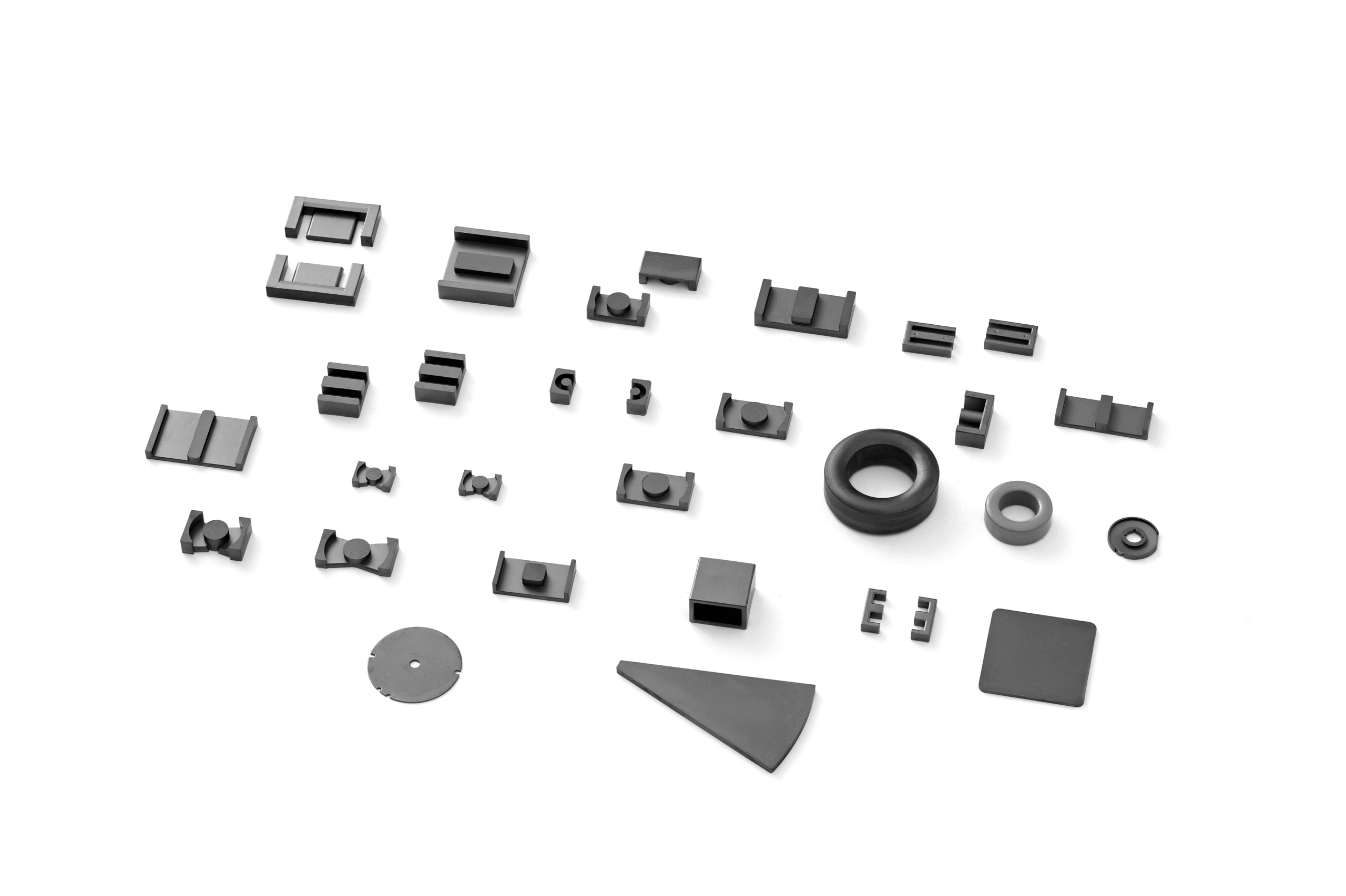
Soft ferrites are ferrite materials that can be easily magnetized and demagnetized using a weak magnetic field. Their basic formula is MeFe2O4, where Me stands for divalent transition metals like Manganese (Mn), Zinc (Zn), Nickel (Ni), Copper (Cu), or Magnesium (Mg). The most common types are Mn-Zn ferrites and Ni-Zn ferrites.
As semiconductors, soft ferrites have high electrical resistivity compared to metallic soft magnetic materials. This allows them to work at very high frequencies without lamination, reducing eddy current losses. They are also low-cost, making them a practical choice for many uses.
However, soft ferrites have some downsides, such as low saturation magnetic flux density and low Curie temperature. Their magnetic properties are also less stable with temperature changes than those of metallic soft magnetic materials. Despite these limitations, soft ferrites are essential in high-frequency applications, like transformers and inductors, and will likely stay important for years to come.