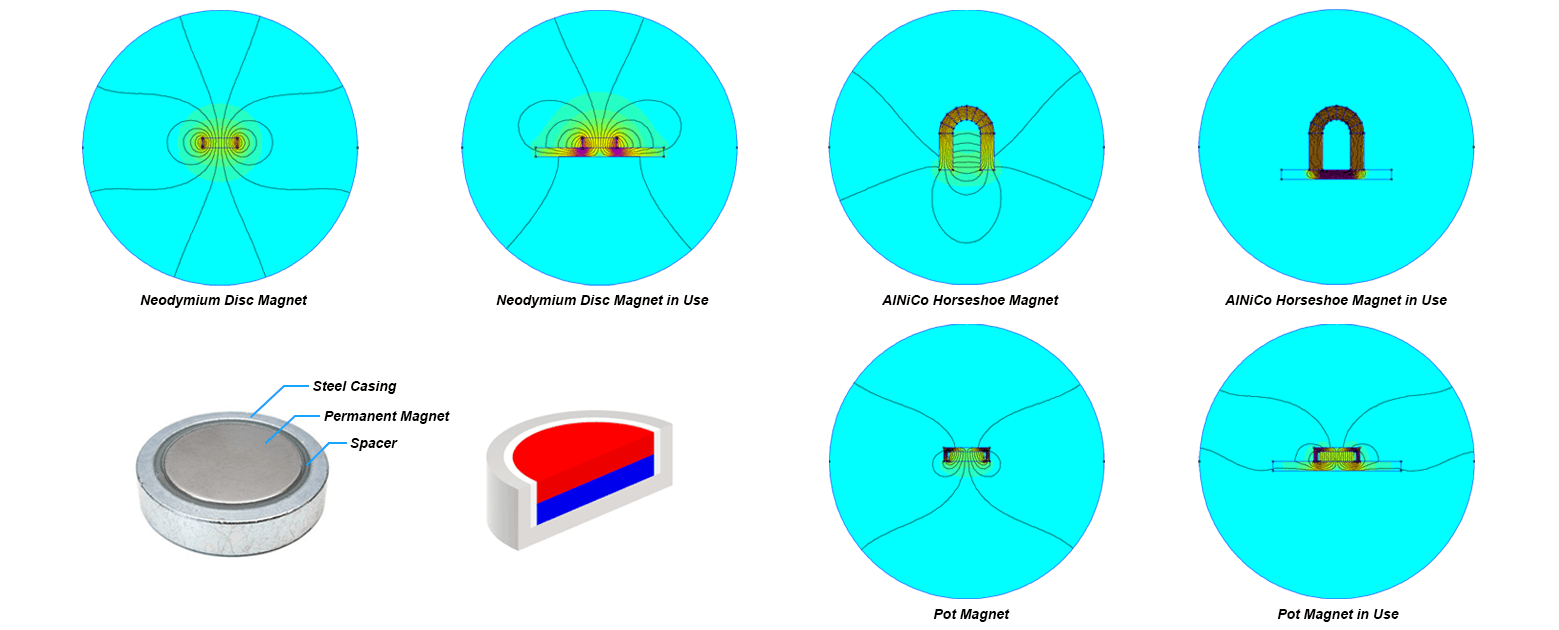
Pot magnets can be classified in several ways, including by their casing design, mounting accessories, and the magnetic material used. In practice, the magnet material is usually the main basis for classification. Common options for pot magnets include Neodymium, Samarium Cobalt, ferrite, and AlNiCo, each offering distinct performance characteristics.
Neodymium pot magnets provide the highest strength-to-size ratio, while ferrite versions offer lower magnetic strength but much lower cost. Samarium Cobalt pot magnets approach Neodymium in performance and deliver superior temperature resistance. AlNiCo pot magnets, whose performance depends heavily on their shape and design, are also well suited for high-temperature applications.
Pot magnets are usually specified by their magnetic force. This force—often called attractive force, holding force, adhesive force, clamping force, or breakaway force—represents the maximum pull force a pot magnet can achieve under ideal conditions. Pull force is typically measured on a clean, high-quality mild steel plate of defined thickness. While the magnet’s construction is the main factor, the actual holding force in an application also depends on several other conditions:
For many Chinese manufacturers, the original design specifications for pot magnets—especially dimensions and pull force data—were first introduced by overseas customers. Unlike permanent magnetic lifters, pot magnets are not designed with a formal safety factor, but they usually include a reasonable pull force margin to cover most typical applications. In order to compete on price, however, some producers deliberately reduce the real pull force to just the nominal value or, in worse cases, exaggerate the labeled performance. Since pot magnets are assembled using adhesive joints, reverse engineering is often limited to demagnetizing, heating to soften the glue, disassembling, and then measuring the components. Over time, this race to cut costs has contributed to a general decline in the overall quality of pot magnets on the market.
Because of this, it is essential to verify the actual pull force of pot magnets under real working conditions, whether the load is applied horizontally or vertically. For critical or high-risk applications, it is advisable to introduce a safety margin by derating the rated pull force by a factor of 2 or more, depending on the possible consequences of failure. Even so, the wide range of mounting designs and compatible accessories continues to give pot magnets strong vitality in the marketplace, greatly expanding their functionality, adaptability, and value in practical use.